References
Working reference material for the Entangled at a Distance universe: traffic models, maps, and infrastructure. Open a section to explore it; models stay paused until opened.
Solar Traffic Model, the Sol corridor from cycler era to story present
Real Kepler orbits and era-correct transfers: chemical-era launch windows are minimum-energy Lambert solutions from a porkchop scan, exactly how real launch dates are chosen (Earth-Mars every 2.1 years, 8-9 month transits), then 0.02 g flip-and-burn torch tracks once MMS commissions, which is also what makes rendezvous with the retrograde hub possible at all. The model pauses automatically at story present (SFUT 500); press Play to continue beyond it. Scroll to zoom, drag to pan.
Full disclosure: this simulator is AI-built to the creator's specifications, a rare and deliberate exception to this project's no-AI-content rule. See the exceptions list in the AI disclaimer.
Yearly statistics
Dispatch rules: ships loop Earth to Mars and back; outbound and return windows are scheduled independently per direction (a chemical-era ship waits about 1.2 years at Mars for return phase, so the pre-MMS steady state is two ships); every window carries all waiting ships; a new ship is commissioned at Earth only when an Earth window fires with no ship parked there; the direct corridor never retires. The cargo cycler rides a permanent Earth-Mars cycling orbit; unmanned crates boost straight up to meet it at each planetary pass and drop straight down at the destination, no crewed ship needed: serviced, then 30 years of automated operation, then retired. Construction dates flagged in the log are working estimates while the codex chronology is reconciled.
Tharsis Industrial Corridor, story sites on real Mars topography
NASA MOLA colorized topography (public domain, Mercator). First the whole planet for scale, then the corridor in detail. Bright markers are story infrastructure; † marks placements fixed by canon description rather than surveyed coordinates.
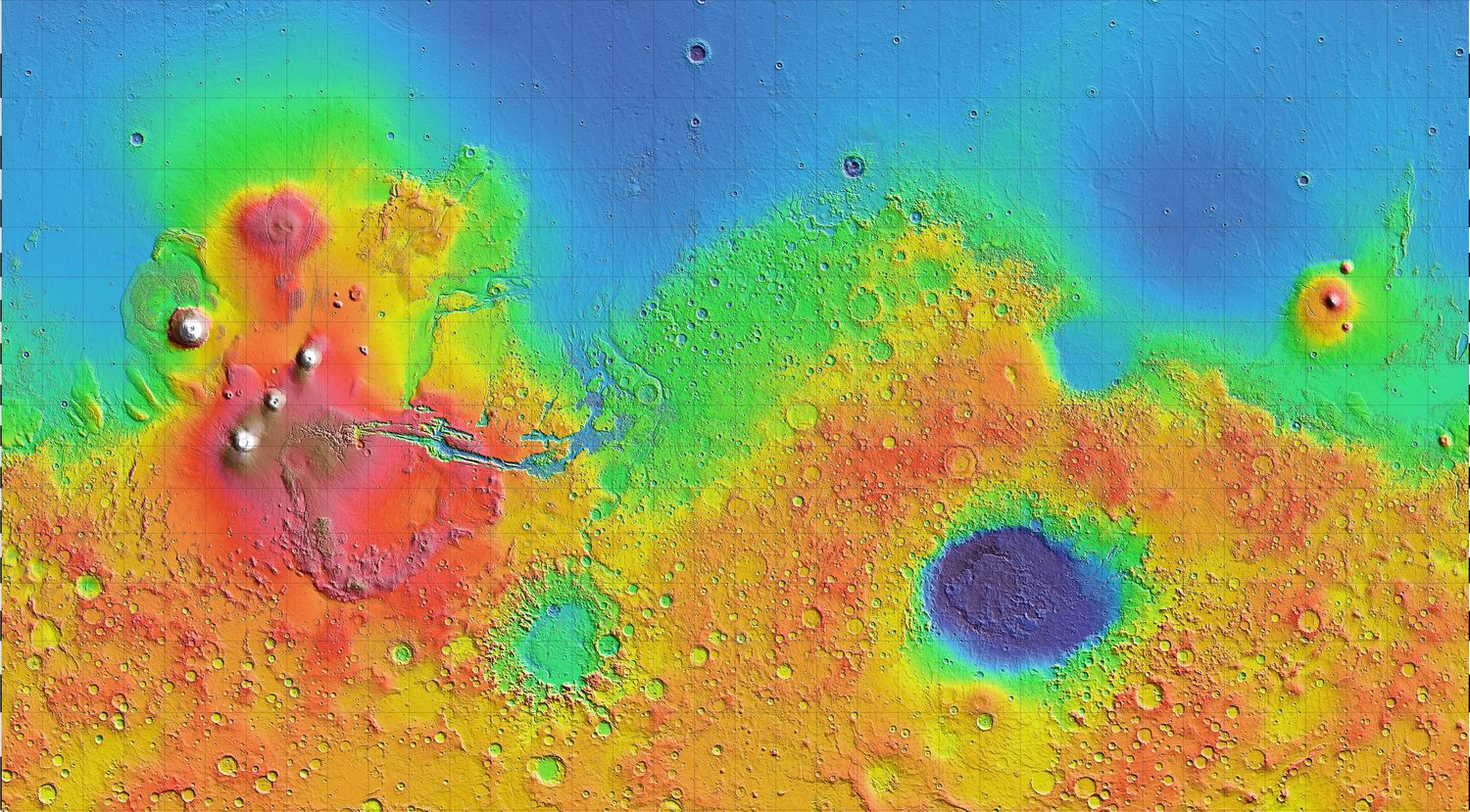
Global context, 70N to 70S: the corridor (outlined) spans roughly a quarter of the western hemisphere. The deep basin on the far side is Hellas Planitia, the largest visible impact structure on Mars.
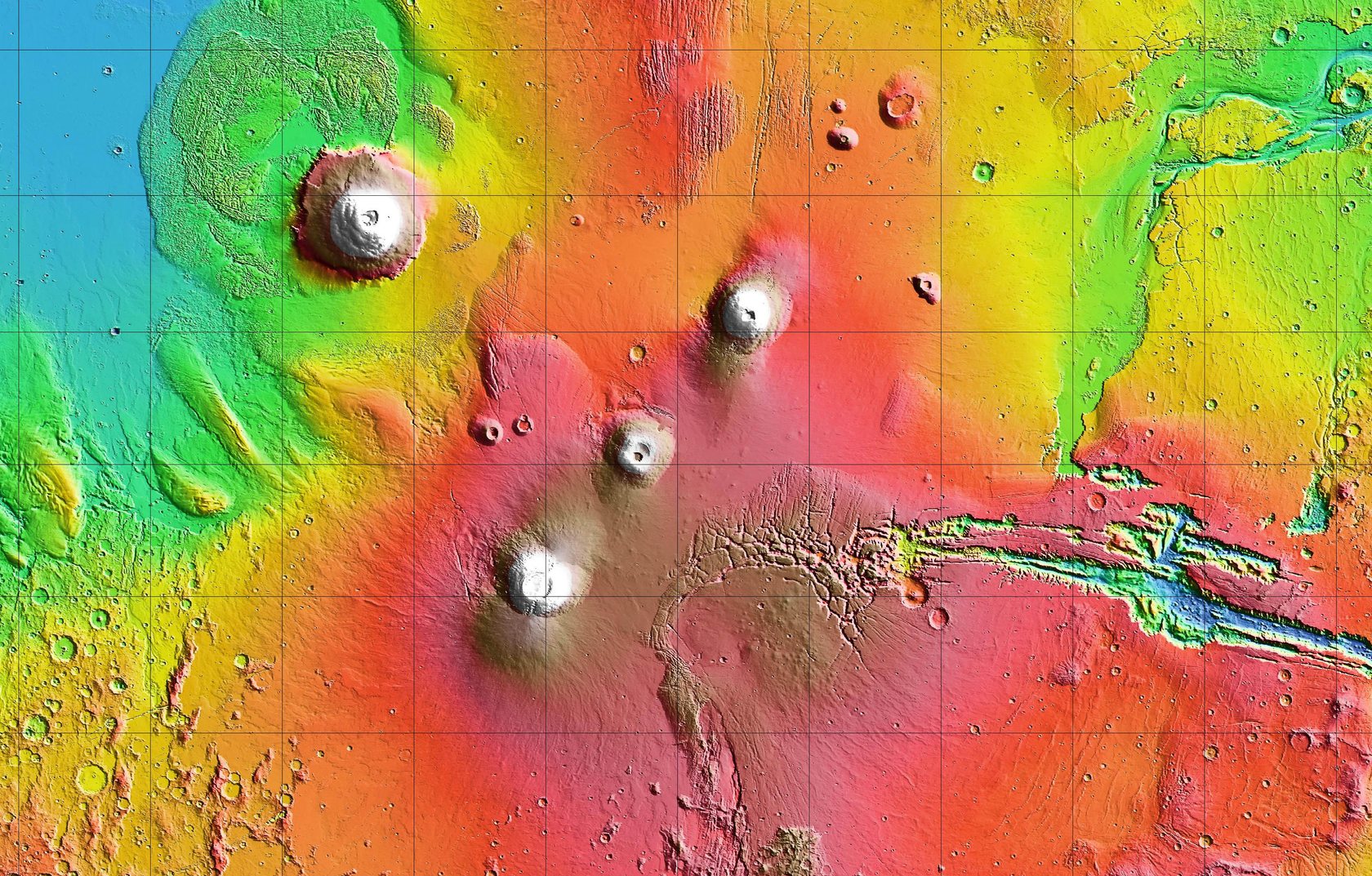
Two rail lines cross at the Pavonis Mons junction (white ring); the canyon line stays inside the deep trench floors: Oudemans into the Ius trench, east through Ius Hub to the Melas basin, where the Candor leg forks north into Candor Chasma and the main line continues down the Coprates neck to Coprates Hub. Measured: Noctis station to Oudemans ~590 km; Oudemans to Coprates Hub ~1,550 km; Candor leg from the fork ~160 km. Hub placements owner-approved; coordinates still nudgeable. Routing between anchors is drawn to plausible grade contours, not surveyed. Base map: NASA / JPL / GSFC Mars Orbiter Laser Altimeter, public domain.
SFUT to Earth time, the decimal clock at a glance
Space Faring Universal Time keeps the second and rebuilds everything above it in clean powers of ten: 100 seconds, then 100 Hundredths, then 10 Tenths, 10 Cycles, 10 Dex. Each row pairs an SFUT unit with the Earth unit whose job it does; the bars show their true relative lengths.
Disclosure: this chart is AI-built to the creator's numbers. See the exceptions list in the AI disclaimer.
The pattern to keep: a Cycle runs almost four hours longer than an Earth day, while an SFUT Year is exactly ten million seconds, a touch under a third of an Earth year. Timestamps read Year.Dex.Cycle : Tenth.Hundredth.Second, counted from the SFUT epoch, and every conversion runs through seconds, the one unit both clocks share.
TIDR in pictures, the framework's own explanatory imagery drawn out
The Time Interaction Density Reality framework explains itself through concrete imagery: light bending into water, walking through rain, threads pulled toward a slit. These diagrams draw exactly that imagery, nothing beyond what the codex describes.
Full disclosure: these diagrams are AI-drawn to the creator's specifications, and they are explicitly temporary placeholders: each one is slated to be replaced by a human-produced illustration. See the exceptions list in the AI disclaimer.
The codex is exact about this one: gravity is not a pull, it is refraction. The edge of a moving wavefront nearer a mass crosses more interactions and effectively slows, the far edge runs freer, and the whole path curves toward the dense region. The inset is the same mechanism at desk scale: light bending as it enters water.
Drops stand in for potential interactions filling the medium. Stand still and they arrive at the ordinary rate. Move, and each subjective moment sweeps through more of them. At light speed a traveler would have to process every drop at once, which is why nothing with mass gets there: the limit is built into how matter sits in the medium, not into engine design.
A directional slit cut into the medium, shown the way the codex describes its grid view: stretched lines converging on each puckered opening, tension holding the lips shut. There is no medium inside the slit, so there is nothing to cross; the far end is simply the next point on the path. The stretched edges run fast, the interior takes no time at all, and an approach at the wrong angle or too little speed slides off along the tension gradient instead of entering.
Before the universe there was only the Infinite, a boundless field of chaotic energy. The Split set off a crystallization: energy converting into matter and antimatter at once, kept apart by a new boundary layer, the medium. The front is still advancing today, and because that growth can never run backward, it hands every interaction inside a built-in direction: the arrow of time.
Why collapse starts slow and finishes fast. Every particle a cloud captures raises its interaction density, which bends passing paths harder, which captures more particles. The mechanism that creates gravity strengthens itself as it works, until the gradient is steep enough to hold moons in orbit. Panel by panel: barely bent paths, then a lean, then a spiral, then a world.